
Traumatic Brain Injury: Facts, Statistics, Risk Factors You Should Know
In today’s fast-paced world, traumatic brain injuries (TBI) have become one of the most pressing public health issues. Whether caused by car accidents, sports collisions, falls, or workplace incidents, TBIs affect millions of people globally every year.
At Sunrise Neuro Acupuncture Integrative Clinic in Ottawa, we not only support patients through their recovery but also analyze global and Canadian statistics, comparing them with what we observe in our acupuncture clinic Ottawa. Our goal is to provide patients, families, and the Ottawa community with clear, research-based insights into TBI treatment and prevention.
What TBIs Are and Their Main Types
A Traumatic Brain Injury (TBI) happens when a sudden force, like a fall, a car accident, or a sports impact, disrupts the normal function of the brain. Sometimes it’s mild and causes temporary symptoms like dizziness or headaches. Other times, it can lead to serious complications that affect movement, memory, and even personality.
Think of the brain as your body’s control center – it manages every thought, movement, and emotion. When it’s jolted or struck, even slightly, the effects can ripple through the entire system. That’s why no head injury should ever be ignored.
Doctors classify TBIs based on how the injury happens and how severe it is. In general, they fall into two main categories:
Closed Brain Injury:
The skull remains intact, but the brain moves or twists inside, causing bruising, bleeding, or swelling. These are common in falls, car crashes, and sports collisions.
Open (Penetrating) Brain Injury:
The skull is fractured or pierced, and the brain tissue is directly damaged. These are less common but usually more severe, often caused by accidents or violent trauma.
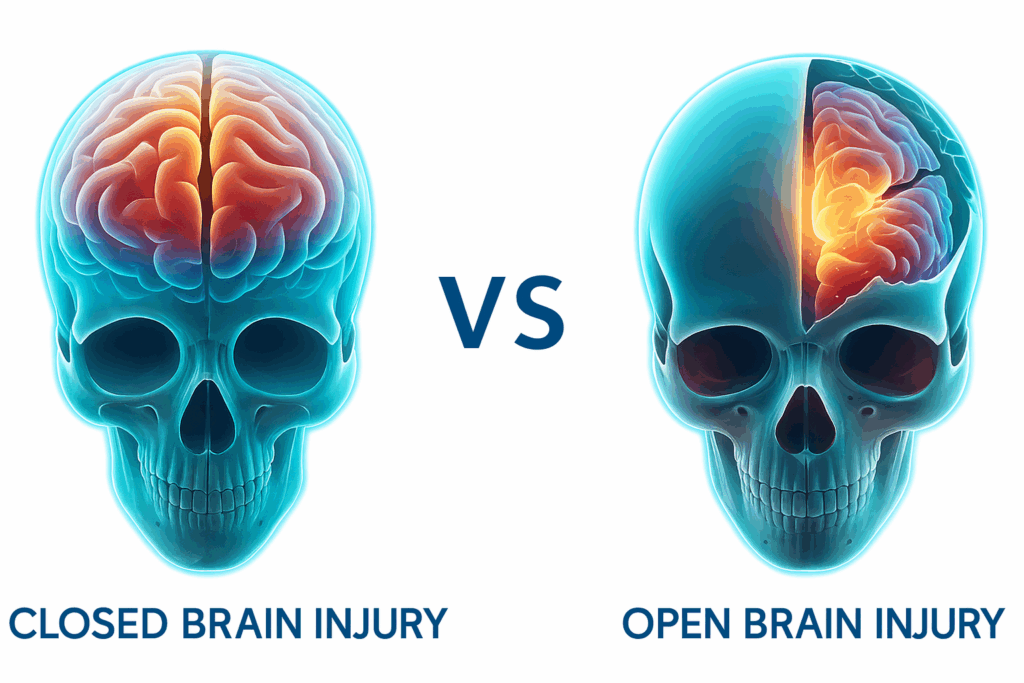
When people hear the term “brain injury,” they might imagine a single condition. In reality, TBI is an umbrella term for a range of injuries.
Within these categories, there are several subtypes of TBI, such as concussions, contusions, diffuse axonal injuries, and chronic traumatic encephalopathy (CTE). Each one affects the brain differently, but they all share one thing: they deserve immediate attention and proper care.
Traumatic Brain Injury Statistics
When you zoom out and look at the world, TBIs aren’t rare, they’re part of everyday life.
The Global Burden of Disease study estimated that in 2021 alone, more than 20 million people sustained a new traumatic brain injury. That’s like the entire population of New York State being injured in just one year. Even more striking, nearly 38 million people worldwide are living with the long-term effects of TBI: headaches, memory loss, balance issues, and more.
But numbers don’t tell the whole story. In Ottawa, when a senior slips on icy stairs in February, or a teenager collides with another player on the hockey rink, they’re part of this same global pattern. Falls dominate the statistics in Canada, while road accidents and sports injuries are leading causes for younger age groups.
A systematic review of international incidence found that TBI incidence in North America is higher than in Europe (e.g. ~331 vs ~228 per 100,000) Cambridge University Press & Assessment
Regions with higher TBI burden (in incidence, prevalence, or YLDs) include: Eastern Europe, Central Europe, Central Asia, high-income North America, Australasia Frontiers+2PMC+2
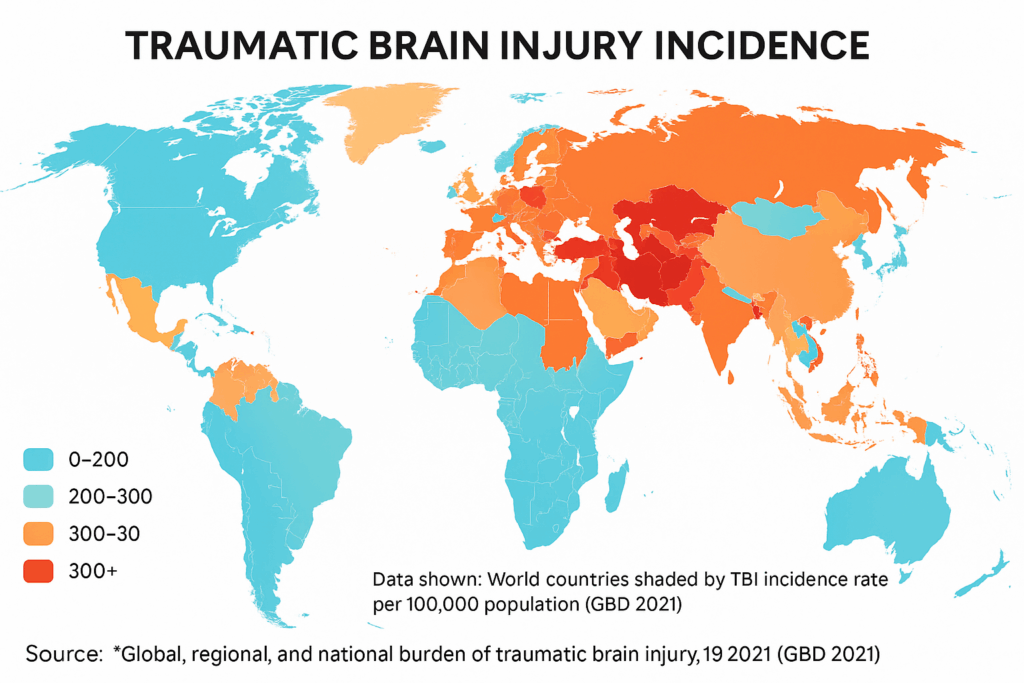
Many studies cover Europe, Australia, Asia, Africa, etc. The incidence and reporting vary widely. ResearchGate+1
Key Global / Regional Findings from GBD
Here’s what the research shows about TBI burden across different countries and regions:
In 2021, there were 20.84 million incident cases of TBI globally (95% UI: 18.13 – 23.84 million) PubMed+2ScienceDirect+
The number of prevalent TBI cases (people living with TBI) globally in 2021 was approx. 37.93 million (95% UI: 36.33 – 39.77 million) ScienceDirect+2PubMed+
📊 Absolute TBI Numbers by Country (2019–2021 Estimates)
Country | Estimated Annual TBI Cases | Notes |
United States | ~2.8 million | CDC data, includes concussions & hospitalizations |
Canada | ~165,000 | Public Health Agency of Canada; many mild TBIs unreported |
China | ~6.5 million | Rapid increase due to urbanization & traffic accidents |
India | ~4.2 million | Road traffic injuries are leading cause |
Germany | ~275,000 | Strong reporting and rehabilitation systems |
Brazil | ~450,000 | Road injuries + sports-related TBIs common |
Global | 55–60 million | Growing trend with aging population & urban risks |
📚 Sources: WHO Global Burden of Disease 2019, PubMed 2021, CDC, Canadian Health Reports
Neuro Acupuncture for TBI
Around the world, scientists are asking the same question our patients ask us in Ottawa: can neuro acupuncture really help the brain heal after injury?
The good news is that research suggests the answer is yes — especially when acupuncture is combined with other rehabilitation methods.
Over the past decade, researchers around the world have been exploring how acupuncture and other integrative therapies can support recovery after a traumatic brain injury. Research findings align closely with the outcomes we witness in practice — as shown in the following case study.
CLINIC CASE STUDY
These findings are important because they show that TBI recovery is not a one-size-fits-all process. Every patient has a different path, and combining approaches often produces the best results.
China Research.
In several hospital-based studies, patients who received scalp acupuncture alongside physiotherapy recovered motor skills faster than those who received standard rehab alone. Doctors noted improvements in movement, coordination, and even speech.
Source: PubMed: 34821939.
United States Research.
Researchers tested microcurrent therapy combined with acupuncture and found that brain injury survivors experienced better balance, fewer headaches, and quicker functional recovery than control groups.
Source: LWW Journal of Head Trauma Rehabilitation, 2025.
See how we use micro current therapy in our clinic.
More integrative clinics in Canada are now combining acupuncture with physiotherapy and occupational therapy, reflecting a growing recognition that mind-body treatments can enhance traditional rehabilitation.
Source: Brain Injury Canada, 2023.
If you’re curious about the details of these studies and what they could mean for patients in Ottawa and across Canada, we’ve created a dedicated article with a deeper dive into the science.
Read our full research review here.
Who Is Most At Risk of TBI?
Traumatic brain injuries do not affect everyone equally. Certain groups of people are more vulnerable depending on age, lifestyle, and environment. Recognizing who is most at risk helps families and communities understand where to focus preventive measures.
Between 1990 and 2021, incident TBI cases increased by ~22.6% in absolute number, though age-standardized incidence rates declined (i.e. population growth and aging contribute) ScienceDirect+2PubMed+
TBI risk by age
Children and Teens
Younger patients are often seen in emergency departments for sports-related concussions. Contact sports such as hockey, football, and soccer carry a higher risk. Playground accidents and bicycle falls are also common causes. While many of these injuries are classified as “mild,” repeated concussions can lead to long-term issues with concentration, learning, and emotional regulation. Parents, coaches, and schools play a vital role in spotting symptoms early and ensuring proper rest and recovery.
Young Adults (15–34 years)
This age group has the highest rate of serious TBIs from motor vehicle accidents. Risk-taking behaviors, high exposure to traffic, and active participation in sports all contribute to this statistic. In Canada and globally, young men in particular are overrepresented in TBI cases. Because this group often represents students, workers, and athletes, TBIs at this stage can have lasting consequences on career development and quality of life.
Seniors (65+ years)
Older adults face a different challenge: falls. Even a simple slip in the bathroom or on icy steps can cause a severe TBI. Age-related changes like reduced bone density (osteoporosis), poor balance, or slower reflexes increase both the likelihood of falling and the severity of outcomes. Hospitalization and mortality rates are highest in this group. For families, this highlights the importance of making homes safe and fall-proof.
📊 TBI by Age Group (Global Data Example)
Age Group | Approx. Global Cases per 100,000 | Common Causes | Notes |
Children (0–14) | 56–75 | Falls, sports injuries, playground accidents | Many cases underdiagnosed; recovery usually faster |
Youth (15–24) | 250–300 | Road accidents, contact sports, assaults | Highest risk group for severe TBI |
Adults (25–44) | 180–220 | Workplace injuries, traffic accidents | Often linked to occupational hazards |
Adults (45–64) | 120–160 | Falls, violence, workplace accidents | Recovery slower than in younger adults |
Seniors (65+) | 200–250+ | Falls, home accidents, frailty-related injuries | Most vulnerable group; highest hospitalization rates |
📚 Source: Global Burden of Disease Study 2019–2021, Public Health Agency of Canada
TBI by Gender
Gender differences also shape how TBIs affect populations and understanding these differences is crucial when designing prevention campaigns, sports safety rules, and workplace protections.
Men are nearly twice as likely as women to suffer a traumatic brain injury. In the U.S. and Canada, hospital records consistently show that men dominate in TBI admissions, largely due to workplace accidents, high-risk sports, and greater exposure to road traffic injuries.
Women, while less frequently injured overall, face significant risks in specific areas. Elderly women have some of the highest hospitalization rates for falls, and intimate partner violence is a notable contributor to TBIs in women globally.
📊 TBI by Gender
Gender | Risk Level | Leading Causes | Notes |
Male | ~2x higher risk than female | Road accidents, contact sports, workplace injuries | Men aged 15–34 are the most at risk globally |
Female | Lower overall risk, but high in seniors | Falls, domestic accidents, partner violence | Women 65+ have high hospitalization rates after falls |
📚 Source: Canadian Institute for Health Information (CIHI), 2022
Common Causes of TBI
When we look at Canadian data and global reports, five main causes of traumatic brain injury appear repeatedly:
- Falls – the leading cause, particularly among seniors.
- Car accidents – Aamajor source of moderate to severe TBI in young adults.
- Sports and recreational activities – especially contact sports like football and hockey.
- Work-related accidents – common in industries with physical labor or heavy machinery.
- Physical assaults – unfortunately, interpersonal violence remains a cause, particularly in vulnerable communities.
What makes TBI especially dangerous is that even mild head trauma can lead to “micro-TBI.” These tiny injuries may not cause immediate symptoms, so people often ignore them. Over time, however, repeated micro-traumas accumulate and can cause:
- Persistent headaches
- Dizziness or balance issues
- Memory problems
- Irritability or mood swings
- Long-term neurological decline
This is why athletes, construction workers, and anyone exposed to repeated head impacts should be carefully monitored.
Subscribe to receive the latest Sunrise Community updates and research based articles
Prevention of TBI
The best “treatment” for traumatic brain injury is prevention. While not every accident can be avoided, many TBIs are preventable through awareness, preparation, and a few simple safety habits. Think of prevention as protecting not only your own health, but also the independence and quality of life of those you love.
Every fall avoided, every helmet worn, and every safe decision behind the wheel makes a difference. Prevention is not just about reducing numbers in a report — it’s about keeping families whole, protecting independence, and making sure our loved ones live safely and fully.
At Home (especially for seniors)
Most TBIs in older adults come from something as simple as a fall. That means prevention often starts right in the living room or bathroom.
- Clear tripping hazards: loose rugs, cluttered hallways, and electrical cords are small details that can lead to devastating falls.
- Install grab bars: bathrooms and stairways are common danger zones; grab bars provide extra security.
- Better lighting: motion-sensor nightlights in hallways can prevent midnight trips and falls.
- Balance and strength exercises: activities like tai chi or yoga can reduce fall risk by improving coordination and stability.
On the Road
Road traffic accidents are one of the leading global causes of TBI, but also one of the most preventable.
- Always wear seat belts: a simple click reduces the risk of serious injury by nearly half.
- Child car seats save lives: ensure seats are age-appropriate and installed correctly.
- Helmets for cyclists, skaters, and skiers: helmets reduce the risk of severe brain injury by up to 85%.
- Avoid distractions and impairment: no text is worth a life, and alcohol or drugs multiply the chances of a serious accident.
In Sports
Sports are healthy and fun, but they’re also one of the most common sources of concussions, especially in children and teens.
- Concussion protocols matter: if an athlete shows symptoms, they must sit out — no exceptions.
- Protective gear is non-negotiable: helmets, face shields, and mouthguards all reduce risks.
- Education is power: parents, coaches, and players need to know the warning signs: headache, dizziness, blurred vision, or confusion.
- Full recovery first: returning to the field too soon can turn one concussion into a long-term disability.
At Work
Workplace safety is not just a legal requirement — it’s a life-saving habit. Industries like construction, manufacturing, and transportation carry higher risks, but TBIs can happen in any workplace.
- Employers must provide safety equipment: hard hats, harnesses, and helmets should always be available and enforced.
- Workers must follow guidelines: even experienced workers are at risk when they cut corners.
- Report unsafe conditions: speaking up can prevent not only your injury, but also protect coworkers.
Personal Injury Lawyer's Perspective on TBI
If a traumatic brain injury (TBI) occurs as a result of a car crash, workplace accident, or negligence, proper documentation can determine whether you qualify for compensation and long-term rehabilitation support.
In Ontario, TBIs are classified as serious injuries under personal injury law. This means that families have specific rights to seek financial support for recovery and rehabilitation — but only if the right steps are taken early.
What families should do:
- Keep all medical notes, test results, and hospital discharge papers.
- Record the time, place, and circumstances of the injury while details are fresh.
- Save all receipts and invoices related to medical care, rehabilitation, and medications.
- Consult a lawyer as soon as possible to understand your rights and what insurance or legal options are available.
If you’re interested in learning how to navigate TBI cases legally, read our exclusive interview with an Ontario-registered personal injury lawyer here.
Table of Contents
Learn more about integrative medicine
Looking for a treatment?
Experience the benefits of Traditional Chinese Medicine with personalized care for your health.