
Why Does Nerve Pain Not Go Away?
Nerve pain can be one of the most confusing and frustrating experiences a person can go through. Unlike a bruise or a pulled muscle, nerve pain often doesn’t follow a predictable healing timeline. It can linger for months, flare up without warning, and resist the remedies that help with other types of pain.
If you’ve been asking yourself why your nerve pain won’t go away, you’re not alone and there are real, biological reasons why this type of pain behaves differently. Chronic nerve pain and persistent nerve pain that simply won’t resolve are among the most common concerns we hear from people seeking answers.
People experiencing ongoing symptoms often begin exploring targeted options, such as nerve pain treatment in Ottawa, as part of understanding what support may be available to them.
What Is Nerve Pain?
Nerve pain is a broad, everyday term used to describe any pain that involves a nerve, whether that nerve is compressed, irritated, inflamed, or injured. It’s the language most people use when describing that sharp, shooting, or burning discomfort that travels along a limb or radiates from the spine.
Neuropathic pain is a more specific clinical term. It refers to pain caused by actual damage or dysfunction within the somatosensory nervous system itself; the system responsible for sensing touch, temperature, and pain. The key distinction is the mechanism: with neuropathic pain, the nervous system isn’t just responding to an external problem. It has become the source of the problem.
To put it simply: all neuropathic pain is a form of nerve pain, but not all nerve pain qualifies as neuropathic pain. A nerve that is temporarily compressed — like when your foot “falls asleep” is nerve pain. Diabetic neuropathy, postherpetic neuralgia (pain following shingles), or phantom limb pain, where damaged nerve tissue generates pain signals on its own, are examples of neuropathic pain.
Under normal circumstances, nerves act as the body’s communication network. They carry signals between the brain, spinal cord, and the rest of the body, alerting you to potential harm. When neuropathic changes occur, this system becomes dysregulated. Nerves may fire spontaneously, send pain signals in the absence of any injury, or amplify ordinary sensations into something intensely painful.
📊 What the research shows:
The International Association for the Study of Pain (IASP) formally defines neuropathic pain as pain caused by a lesion or disease of the somatosensory nervous system — a definition refined over time to emphasize structural damage rather than dysfunction alone. Researchers have noted a striking paradox at the heart of neuropathic pain: it frequently involves both sensory loss and heightened pain sensitivity in the same area simultaneously — a combination that simply doesn’t occur in ordinary pain conditions, and one that helps explain why it can be so confusing to experience.1
What Causes Nerve Pain?
Nerve pain can arise from a wide range of underlying causes. Some of the most common include:
- Nerve compression. When a nerve is physically compressed or pinched, such as in sciatica (where the sciatic nerve is irritated, often by a herniated disc), pain can radiate along the entire path of that nerve.
- Inflammation. Inflammatory conditions can irritate surrounding nerve tissue, leading to ongoing pain even as the primary inflammation settles.
- Nerve injury. Physical damage to a nerve, whether from an accident, surgery, or repetitive stress, can disrupt normal signaling patterns.
- Chronic conditions. Conditions such as diabetes, autoimmune disorders, and infections can cause peripheral neuropathy, where the nerves in the hands, feet, or legs are progressively affected.
- Trigeminal neuralgia. A specific condition affecting the trigeminal nerve in the face, causing intense, electric shock-like pain in the jaw, cheek, or teeth.
What Does Nerve Pain Feel Like?
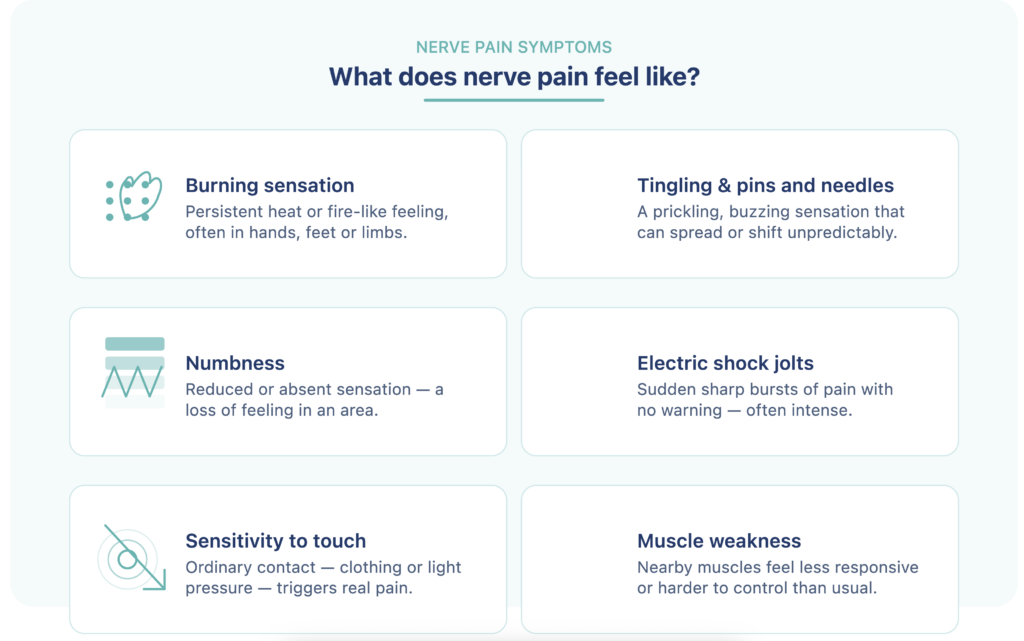
These symptoms can come and go, or they may be constant. They may be confined to one area or spread across a wider region. The unpredictability is part of what makes chronic nerve pain so difficult to manage.
If these symptoms persist or keep returning, it may indicate ongoing nerve involvement that requires targeted support rather than a wait-and-see approach.
Why Does Nerve Pain Become Chronic?
One of the most important things to understand about nerve pain is why it can persist long after an initial injury or event seems to have resolved.
The nervous system has a remarkable but sometimes problematic ability to adapt, a process known as central sensitization. When nerve pain signals are sent repeatedly over time, the central nervous system can essentially become “tuned” to that pain. The brain and spinal cord begin to process those signals with heightened sensitivity, even when the original cause is no longer present.
Think of it like a volume knob that has been turned up and stuck in place. The input (the original injury or nerve irritation) may have reduced, but the nervous system continues to amplify the output.
This is also why nerve pain can sometimes spread or intensify without an obvious explanation. The problem has shifted from the original source to the way the nervous system is processing and responding to signals.
For people dealing with conditions like peripheral neuropathy, sciatica, or post-injury nerve damage, this sensitization process is a key reason why pain persists and becomes chronic.
📊 What the research shows:
Research into central sensitization has identified that the process involves real, measurable changes in how neural networks are wired and connected — not simply a psychological response to pain. Studies have highlighted the role of specific cellular receptors and chemical messengers in driving this rewiring, which helps explain why persistent nerve pain can feel so self-sustaining. Importantly, research also suggests that chronic nerve pain is frequently accompanied by anxiety, disrupted sleep, and low mood — not as separate issues, but as conditions that share the same altered neural pathways.2
How the Nervous System Is Involved
To understand why nerve pain is so persistent, it helps to have a basic picture of how the nervous system works.
The nervous system is divided into the central nervous system (the brain and spinal cord) and the peripheral nervous system (the network of nerves that extends into the limbs and organs). Pain signals begin at the peripheral level, in the skin, muscles, and tissues, and travel inward to the spinal cord, which relays them up to the brain for processing.
When a nerve is damaged or irritated, it may begin firing abnormally, sending signals when it shouldn’t, or sending stronger signals than the situation calls for. Over time, the spinal cord’s relay stations and the brain’s processing centers can adapt to this abnormal input, becoming more reactive as a result.
This is why approaches to chronic nerve pain often need to consider the entire nervous system, not just the site where symptoms are felt. Addressing only the local area may not be enough if the nervous system itself has become sensitized.
Subscribe to receive the latest Sunrise Community updates and research based articles
Support Approaches for Nerve Pain
Managing nerve pain is rarely a one-size-fits-all process. For many people, a combination of approaches: medical, therapeutic, and complementary offers the most meaningful support.
🔬A clinical study published in the Journal of Pain (2024) by Wei, Wang, Shi and colleagues focused specifically on patients with chronic sciatica. Comparing real acupuncture to sham acupuncture over 10 sessions, the study found meaningful improvements in both leg pain and functional disability in the acupuncture group. Using neuroimaging, the researchers also observed increased spontaneous neural activity in brain regions associated with sensory processing — the right superior parietal lobule and postcentral gyrus — suggesting that acupuncture’s effects may extend to how the brain itself registers and responds to pain.
Neuro Acupuncture for Nerve Pain
Neuro Acupuncture is an area of growing clinical interest, with research exploring how needle stimulation may influence pain signalling pathways in both the peripheral and central nervous system.
From a physiological standpoint, acupuncture is understood to stimulate sensory nerve fibres at specific anatomical points, which may trigger the release of endogenous pain-modulating compounds — including endorphins — and activate descending pain control pathways in the brain and spinal cord. Research also suggests acupuncture may help regulate pain-related ion channels and reduce inflammatory signalling in spinal cord tissue, potentially addressing some of the mechanisms that drive nerve pain at a deeper level.
If you’d like to learn more about what may be available to you, we invite you to explore our page on nerve pain treatment in Ottawa, where you can find more information about our approach and how to get started.
Recovery is not a straight line. There will be good days and challenging days. What matters is consistent effort, appropriate support, and the courage to explore treatments that might help you reach your fullest potential. Neuroacupuncture is one more tool in your recovery toolkit—a tool backed by thousands of years of clinical experience and increasingly by modern research.
This article is for informational and educational purposes only and is not a substitute for professional medical advice, diagnosis, or treatment. Always seek the advice of your physician or other qualified health provider with any questions you may have regarding a medical condition. Never disregard professional medical advice or delay in seeking it because of something you have read in this article.
Table of Contents

About Denis Grounin →
Denis Grounin, former ER nurse practitioner, R.TCMP, R.Ac, is the Founder of Sunrise Neuro Acupuncture Integrative Clinic in Ottawa with over 30 years of acupuncture experience and neurological training since the 1990s. His work focuses on neuro-acupuncture, rehabilitation support, and integrative neurological care.
Learn more about integrative medicine
Looking for a treatment?
Experience the benefits of Traditional Chinese Medicine with personalized care for your health.