
How Different Professions in Ottawa Can Affect Physical Health
Most people don’t connect their pain to their job, at least not immediately.
It starts as tension at the end of a long day. Then it’s there in the morning too. Then it’s there on weekends. By the time someone describes it as a problem, it has usually been building for months — sometimes years — through the accumulated effect of doing the same job, in the same posture, with the same movement patterns, day after day.
This is what occupational pain looks like. Not a dramatic injury. Not a single incident you can point to. But a gradual accumulation that the body absorbs until it can’t anymore.
Ottawa is a city where this accumulates in particular ways. Government offices, hospitals, law firms, dental clinics, construction sites, music studios – each of these environments creates a specific physical demand that eventually registers in the body. The patterns are not random. They are well-documented in research, recognizable across professions, and, importantly, addressable when understood correctly.
At Sunrise Neuro Acupuncture Integrative Clinic in Westboro, Ottawa, occupational pain is one of the most consistent presentations Denis sees — from federal government employees with chronic neck tension to massage therapists with wrist strain to nurses recovering from 12-hour shift fatigue. This article is the starting point for a series that looks at that pain profession by profession.
The Scale of the Problem
The numbers are large enough to warrant attention.
The World Health Organization estimates that approximately 1.71 billion people worldwide live with musculoskeletal disorders and that between 50 and 70% of those cases involve workers across various occupations 1.
The Global Burden of Disease Study 2021, published in The Lancet, found that musculoskeletal conditions account for 6.7% of global disability-adjusted life years — making them one of the leading contributors to years lived with disability worldwide. A 2025 analysis projecting these trends to 2035 estimates the number of people affected will rise to 2.16 billion as populations age and sedentary work patterns expand 2.
In Canada specifically, musculoskeletal injuries are among the most common causes of workplace absence and disability claims. They are not concentrated in physically demanding industries alone — desk-based workers, healthcare professionals, and service industry workers all carry significant occupational musculoskeletal burden.
What these numbers describe, at the individual level, is a working person whose body is being slowly shaped by what their job asks of it and who is often managing the consequences quietly, without a clear framework for understanding what is happening or what to do about it.
How Occupational Pain Develops
Work-related musculoskeletal disorders rarely begin with a single incident. They develop through one or more of three mechanisms and most occupational pain involves more than one operating simultaneously.
- Sustained static load
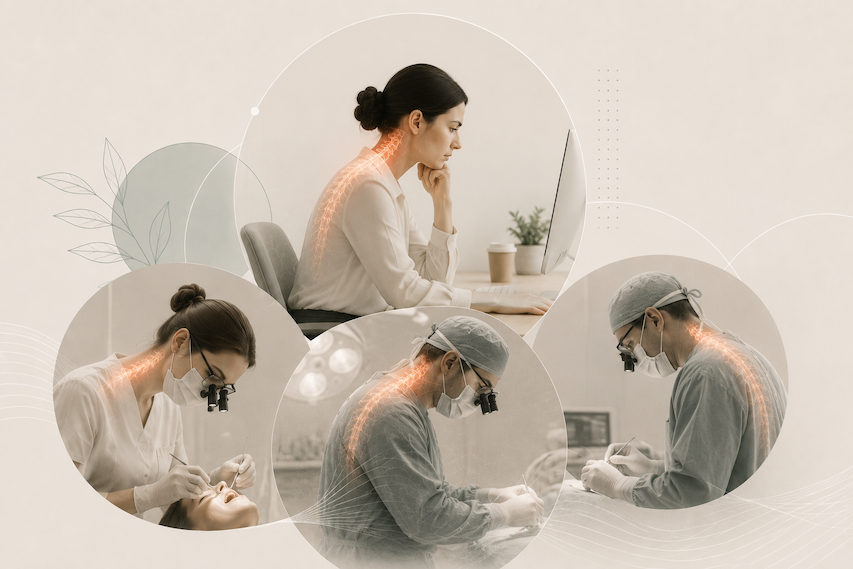
When a part of the body is held in a fixed position for extended periods, the muscles maintaining that position are under continuous low-level tension. This is distinct from the acute effort that produces immediate fatigue. It is more like holding a book at arm’s length for six hours, manageable in the short term, cumulative over time.
Office workers holding their neck in a fixed screen-facing position, dental hygienists maintaining lateral flexion over a patient, surgeons sustaining a precise posture during a procedure, all are experiencing sustained static load. The tissue tolerates it. Until it doesn’t.
- Repetitive movement under load
When the same movement is performed repeatedly, often under some degree of force or at the end of range, the structures involved — tendons, muscles, joint surfaces, nerves — experience cumulative microtrauma. Recovery between repetitions becomes insufficient over time.
A massage therapist performing effleurage strokes across dozens of patients per week. A lawyer’s hands moving through hundreds of pages of document review. A construction worker swinging a hammer. The movement itself is manageable. The repetition, sustained over months and years, is where the problem develops.
- Psychosocial load and nervous system activation
This is the mechanism most commonly overlooked and for Ottawa’s workforce, arguably the most relevant.
Sustained cognitive effort, deadline pressure, performance demands, and chronic low-grade workplace stress create a physiological environment that increases muscle tension, particularly in the neck, shoulders, and upper back. The body’s stress response activates the same muscles involved in posture and movement, adding a layer of tension to an already-loaded system.
Research consistently shows that psychosocial factors: job demands, lack of control, poor social support at work are independent predictors of musculoskeletal pain, not simply consequences of it 3. In a city where federal policy deadlines, legal proceedings, and healthcare pressures are daily realities, this mechanism deserves to be taken seriously.
Why Occupational Pain Sometimes Doesn't Resolve
This is the question that brings many Ottawa workers to our Westboro clinic.
The heavy work period ended. The project finished. The caseload lightened. But the pain stayed.
When occupational pain has been present for more than a few months, the nervous system’s role in maintaining it becomes increasingly important. The same process of nervous system sensitization that we describe in detail in our article on why pain can continue after the original cause has resolved applies directly to persistent occupational pain.
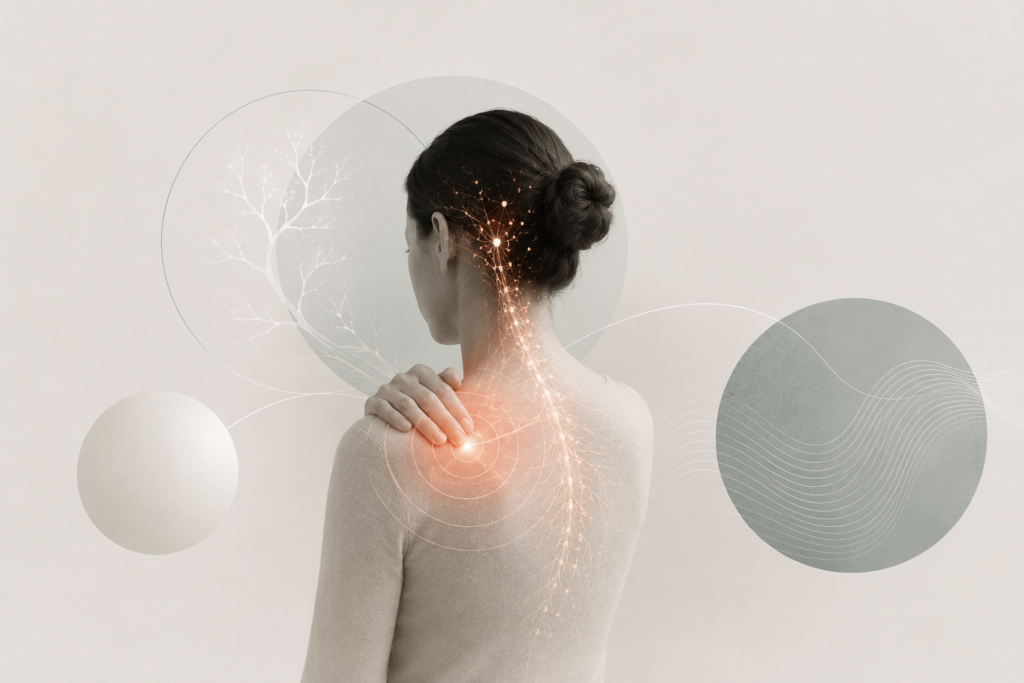
In brief: when pain signals fire consistently over an extended period, the nervous system can become more responsive to those signals over time. Pain that began as a clear response to physical load can continue to be generated and amplified by a nervous system that has adapted to producing it. The original physical cause may have reduced. The nervous system’s learned response has not.
This is not a psychological explanation for pain. It is a neurological one — and understanding it changes what kind of approach is actually useful. Ergonomic adjustments address the ongoing physical input. Neuroplasticity – the nervous system’s capacity to adapt and recalibrate – is what allows the pain response itself to shift.
What the Review Says About Acupuncture Specifically
Many Ottawa residents searching for a registered acupuncturist in Ottawa arrive specifically because of occupational pain that hasn’t resolved through rest or physiotherapy alone. Each profession below represents a distinct pattern and a distinct reason why people in that field seek integrative care.
Government and office workers carry the burden of prolonged static posture, screen-facing neck position, and the particular psychosocial load of high-stakes desk work. Neck pain, upper back tension, and tension-type headaches are the dominant presentations. The rapid shift to hybrid work added inconsistent ergonomic environments — well-documented as a contributor to increased musculoskeletal pain in office-based workers. 4 This is one of the most common presentations seen at acupuncture clinics in Ottawa serving the downtown and Westboro areas.
Healthcare workers – doctors, nurses, physiotherapists, dental hygienists – face some of the highest occupational musculoskeletal burden of any professional group. The global prevalence of low back pain among healthcare workers is estimated at up to 58%. 5 Patient handling, prolonged standing, precision work postures, and irregular shift patterns all contribute. Many Ottawa hospital workers seek integrative pain support — including acupuncture for chronic pain in Ottawa — alongside their workplace physiotherapy.
Legal professionals combine sustained desk-based work with the particular demands of court preparation and delivery — sustained concentration, postural demands of reading and writing for extended periods, and the significant psychosocial load of adversarial professional environments. Ottawa’s legal community, concentrated around Parliament Hill, the courts, and Centretown, represents a population where occupational neck and upper back pain is common and frequently undertreated.
Trades and construction workers carry a different profile – rotator cuff strain from overhead work, knee pain from prolonged kneeling, lower back from lifting and bending — but share with desk workers the common thread of repetition and cumulative load over years of practice. Electro-acupuncture in Ottawa is one of the approaches used specifically for musculoskeletal strain in physically demanding professions.
Massage therapists and manual practitioners occupy a specific niche: their work involves high repetition, sustained force through the hands and thumbs, and postural demands that most people outside the profession don’t see. Thumb pain, wrist strain, and shoulder fatigue are occupational hazards that a significant proportion of practicing therapists experience. Ottawa’s RMT community is one of the groups we are actively reaching out to for this series.
Musicians – relevant in Ottawa given the National Arts Centre Orchestra and a vibrant independent music scene — carry some of the most precisely documented occupational pain profiles in the literature, with specific patterns tied to specific instruments.
Each of these professions is the subject of a dedicated article in this series, linked below.
What the Evidence Supports
for Occupational Pain
Across professions and pain sites, a few consistent findings emerge from the research on what actually helps with work-related musculoskeletal pain.
Movement and exercise are the most consistently supported interventions across all occupational pain presentations – not rest, and not a specific type of exercise. The key variable is sustained regular movement that provides the musculoskeletal system with varied, non-threatening input and addresses the deconditioning that accompanies chronic pain avoidance.
Ergonomic modification matters, particularly in the early stages and for prevention, but research consistently shows it is insufficient on its own for people with established pain. 3 It reduces ongoing input. It does not address what the nervous system has already learned.
Addressing psychosocial factors — workload, autonomy, social support — has a measurable effect on musculoskeletal pain outcomes independent of physical interventions. This is one reason why purely physical approaches often produce incomplete results for people in high-demand professions.
Acupuncture has a documented evidence base for several of the most common occupational pain presentations — including neck pain, low back pain, and shoulder conditions — with proposed mechanisms involving both local tissue effects and central nervous system modulation of pain processing. We cover the specific evidence for individual conditions in each profession article. For Ottawa professionals new to acupuncture, our guide on what to expect at a first acupuncture appointment in Ottawa and information on whether acupuncture is covered by insurance in Ontario are practical starting points.
At our neuro-acupuncture clinic in Ottawa in Westboro, we approach occupational pain from both directions: the local musculoskeletal presentation and the nervous system context that may be maintaining it. For many Ottawa professionals, that dual approach is what has been missing from their care. If you are comparing options, our page on what makes acupuncture clinics in Ottawa different covers what to look for in a practitioner for occupational pain specifically.
What the Evidence Supports
for Occupational Pain
Most occupational pain responds well to early, appropriate intervention. A few patterns warrant prompt medical assessment rather than a wait-and-see approach:
- Pain accompanied by progressive weakness, numbness, or tingling in the limbs
- Sudden onset of severe pain not explained by a known activity
- Pain that is constant, unrelenting, and unaffected by position or rest
- Pain accompanied by unexplained weight loss, fever, or systemic symptoms
- Any neurological change — loss of coordination, bladder or bowel changes
These are uncommon in typical occupational presentations but important to recognize. If any of these features are present, a physician assessment should be the first step before pursuing any other intervention.
If You Are an Ottawa Professional Dealing With Occupational Pain
Whether you are a government employee in Westboro, a nurse at the Civic Hospital, a lawyer in Centretown, or a trades worker in Kanata — if occupational pain has been present longer than expected, a clinical assessment can help clarify what is maintaining it and what approaches are most appropriate for your specific situation.
Sunrise Neuro Acupuncture Integrative Clinic is located at 421 Richmond Rd, Suite 202 in Westboro, Ottawa. Denis Grounin is a registered acupuncturist in Ottawa with over 30 years of clinical experience, specialising in neurological and musculoskeletal presentations.
Frequently asked questions
Because once pain has been present for several months, the nervous system's role in maintaining it becomes as important as the original physical cause. The same musculoskeletal load that started the pain may have reduced — but the nervous system can continue generating pain signals through a process called sensitization. Time off reduces the ongoing physical input but doesn't automatically recalibrate how the nervous system is processing those signals. This is why rest alone is often insufficient for longer-standing occupational pain, and why approaches that engage the nervous system directly tend to produce better results. Our article on why pain can continue after the original cause has resolved covers this in more detail.
Research documents high prevalence across several professional groups common in Ottawa. Healthcare workers — including nurses, dental hygienists, and OR staff — carry some of the highest burden, with low back pain prevalence estimated at up to 58% in some studies. Government and office workers experience high rates of neck and upper back pain, particularly following the shift to hybrid work arrangements. Legal professionals, massage therapists, trades workers, and musicians each carry distinct pain profiles documented in the occupational health literature. Each is covered in a dedicated article in this series.
Acupuncture has a documented evidence base for several of the most common occupational pain presentations — including neck pain, low back pain, and shoulder conditions. It is not condition-specific in the way that some interventions are. The proposed mechanisms involve both local effects on muscle tension and tissue, and central effects on how the nervous system processes pain signals — which is particularly relevant for occupational pain that has become chronic. A registered acupuncturist in Ottawa can assess whether acupuncture is appropriate for your specific presentation following an initial consultation.
Many extended health benefit plans in Ontario include acupuncture coverage — typically a set annual amount ranging from $300 to $500, though this varies significantly by plan. Provincial government employees and federal public servants generally have plans that include acupuncture when provided by a Registered Acupuncturist (R.Ac.). MVA-related occupational injuries may be covered under Ontario's Statutory Accident Benefits Schedule. We provide official receipts for all treatments for insurance submission. A dedicated article on acupuncture insurance coverage in Ontario covers the specifics in detail.
💡 Remember
Recovery is not a straight line. There will be good days and challenging days. What matters is consistent effort, appropriate support, and the courage to explore treatments that might help you reach your fullest potential. Neuroacupuncture is one more tool in your recovery toolkit—a tool backed by thousands of years of clinical experience and increasingly by modern research.
Scientific References
- World Health Organization. (2022). Musculoskeletal health facts. View →
- Liu, M. et al. (2025). Global, regional, and national burden of musculoskeletal disorders, 1990–2021: an analysis of the global burden of disease study 2021 and forecast to 2035. Frontiers in Public Health. View study →
- Darvish, M. et al. (2025). Demographic and occupational determinants of work-related musculoskeletal disorders: a cross-sectional study. International Journal of Environmental Research and Public Health. View study →
- Holtermann, A. et al. (2023). The longitudinal association between working from home and musculoskeletal pain during the COVID-19 pandemic. International Archives of Occupational and Environmental Health, 96(1). View study →
- Al-Mohrej, O.A. et al. (2023). Prevalence and predictors of back pain among primary healthcare workers. Journal of Multidisciplinary Healthcare. View study →
This article is for informational and educational purposes only and is not a substitute for professional medical advice, diagnosis, or treatment. Always seek the advice of your physician or other qualified health provider with any questions you may have regarding a medical condition. Never disregard professional medical advice or delay in seeking it because of something you have read in this article.
Table of Contents

About Denis Grounin →
Denis Grounin, former UCI & ER nurse practitioner, R.TCMP, R.Ac, is the Founder of Sunrise Neuro Acupuncture Integrative Clinic in Ottawa with over 30 years of acupuncture experience and neurological training since the 1990s. His work focuses on neuro-acupuncture, rehabilitation support, and integrative neurological care.
Learn more about integrative medicine
- All
- Gastrointestinal
- Infections
- integrative medicine
- Mental
- Musculoskeletal
- Neurological
- Skin
- Women's Health
Low Back Pain Treatment in 2026: What Research Now Shows

What Is Neuroplasticity? The Brain’s Ability to Adapt
What Is Neuro Acupuncture? A Guide for Patients and Families
Looking for a treatment?
Experience the benefits of Traditional Chinese Medicine with personalized care for your health.