

SunRise

Speech Delay in Toddlers: When Should Parents Be Concerned?

by Sunrise Neuro Acupuncture Integrative Clinic
February 26 , 2026
6 min read

“Is it normal that my 2-year-old isn’t talking yet?” It’s one of the most common questions parents ask, and one of the most anxiety-provoking. The honest answer is: sometimes it’s just timing, and sometimes it’s a sign worth looking into sooner rather than later.

This post won’t give you a diagnosis. What it will give you is a clear picture of the milestones, the red flags that genuinely matter, and the kind of questions worth bringing to a professional, so you can stop second-guessing Google at 11pm.

What "Speech Delay" Actually Means

Speech delay simply means a child isn’t hitting expected verbal milestones for their age. But it’s worth separating two things that often get confused:

Speech is how a child produces sounds and words. Language is how they understand and communicate, including pointing, following instructions, and making eye contact to get your attention.

A child can have a speech delay with strong language comprehension (they understand everything, they just aren’t talking much), or they may show delays across both. That distinction matters a great deal when it comes to what kind of support helps most.

[1]“The American Academy of Pediatrics recommends developmental surveillance at every well-child visit, with updated evidence-based milestones released in 2022 to reflect skills achieved by at least 75% of children.”

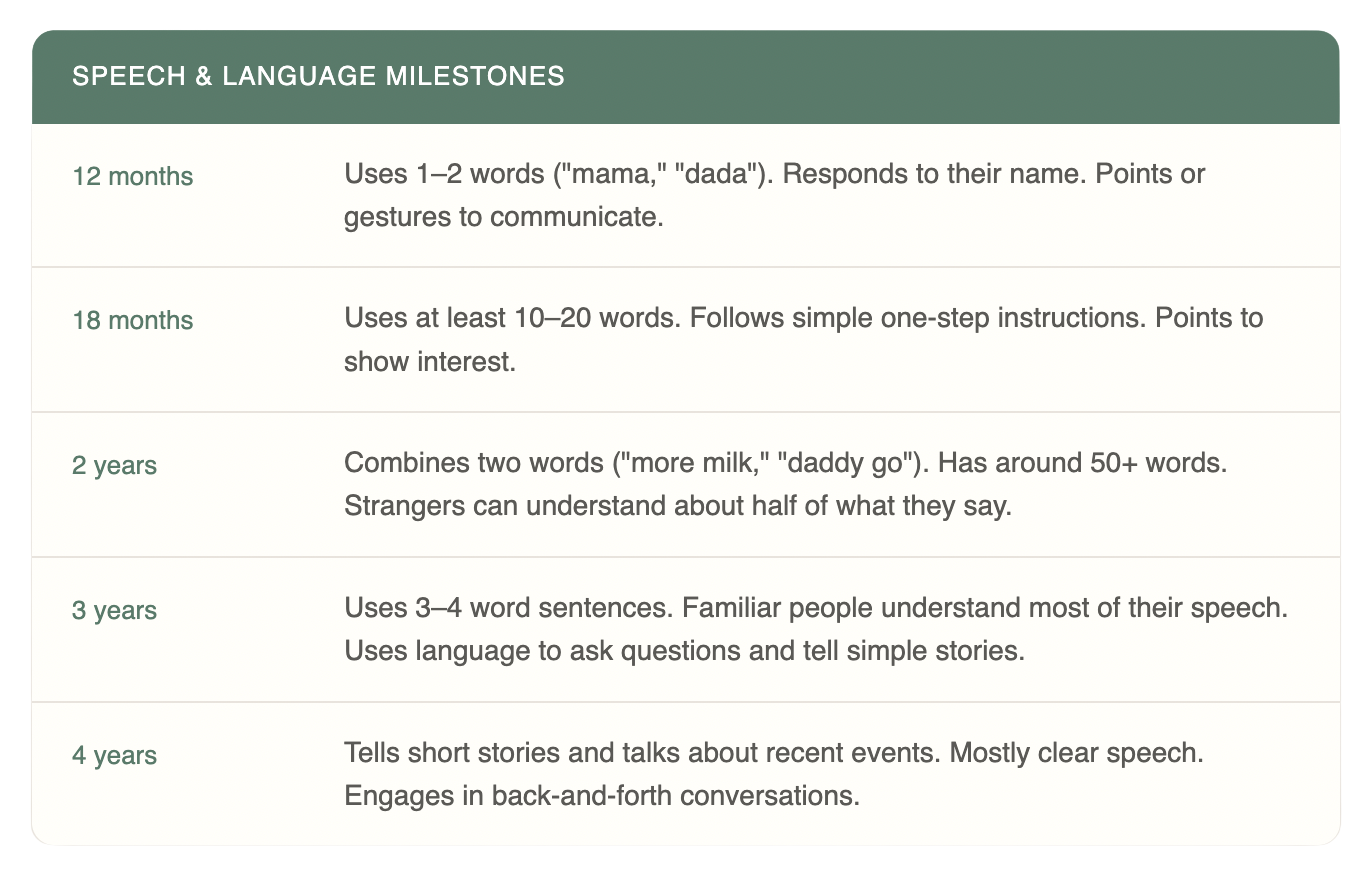
Typical Milestones at a Glance

These are general guidelines, not rigid rules. Every child is different, but these benchmarks give professionals a shared starting point.

Missing a milestone by a few weeks is rarely a concern. Missing it by several months, especially across multiple areas at once, is worth a conversation with a professional.

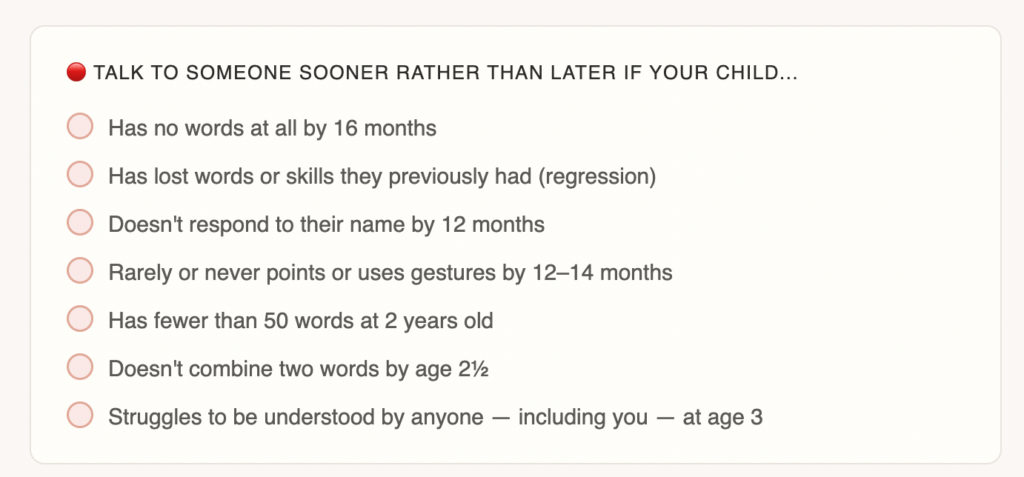
Signs That Warrant Early Attention

Some signs are clearer than others. These aren’t meant to alarm you, they’re meant to help you move quickly if something is actually going on, because early support genuinely makes a difference.

This is why the early years matter -> brain neuroplasticity is at its highest in early childhood and directly shapes how language pathways develop

speech delay signs

WORTH KNOWING

Loss of previously acquired language is always worth prompt attention, this is one sign that should not be in a “wait and see” category, regardless of age.

[2]“Research confirms that parental concern is one of the most reliable early indicators of developmental delay — and should be taken seriously rather than dismissed.”

Common Reasons for Speech Delay

There’s rarely a single cause. Some of the most common contributors include:

Hearing issues. 
Hearing loss (even mild), partial, or fluctuating (as with recurring ear infections) – directly affects language development. A hearing assessment is often one of the first things a professional will recommend.

Developmental differences. 
Autism spectrum disorder, developmental language disorder, or global developmental delay can all present with speech related challenges and communication regulation difficulties. Early identification opens the door to tailored support much sooner.

Differences in how the nervous system processes input. Some children have difficulty with sensory regulation or attention in ways that affect their readiness to engage with language. This is an area where understanding the nervous system’s role can be genuinely useful, and often overlooked.

Environmental and social factors. Multilingual households, limited language exposure, or high stress in the home environment can all play a role, though these are usually easier to address with the right guidance.

[3]“A 2023 study examining risk and protective factors for speech and language disorders found that neurological processing differences — including sensory regulation — are significantly associated with speech and language delay in children aged 2 to 6.”

The "Wait and See" Problem

Parents are sometimes told to wait and see if their child catches up. This advice is well-intentioned, but it has real costs when applied too broadly.

Research consistently shows that the earlier a child receives appropriate support, the better the outcomes. The brain’s plasticity, its ability to build new connections and compensate, is most powerful in the early years. Waiting, in some cases, means missing that window.

That doesn’t mean panicking at every delayed word. It means knowing which signs actually warrant action, and not dismissing parental instinct when something feels off.

[4]“A 2023 study published in the Journal of Communication Disorders found that children who received early language intervention stabilised or improved their language proficiency — preventing the gap between delayed and typically developing children from widening further.”

[5]“A 2022 review published in the Handbook of Clinical Neurology confirms that brain plasticity for language is most active in the early years — and that the timing of intervention directly influences long-term language outcomes.”

A gentle reminder: Seeking an assessment doesn’t mean something is catastrophically wrong. It means you’re paying attention. Even when assessments come back showing nothing significant, they provide peace of mind — and often useful strategies regardless.

Subscribe to receive the latest Sunrise Community updates and research based articles

What Parents Can Do Right Now

While you’re seeking professional guidance, there are things that consistently support language development at home:

Simple things that may be supportive:
 
🔘 Narrate your day in simple language: describe what you’re doing as you do it
 
🔘 Get face-to-face at your child’s level when talking
 
🔘 Reduce background noise during one-on-one interaction
 
🔘 Follow your child’s lead: talk about what they’re already paying attention to
 
🔘 Give them time to respond: silence can feel uncomfortable, but it’s valuable
 
🔘 Read together daily, even if they’re not yet talking

When to Seek a Professional Assessment

If you’re concerned, even if you can’t quite articulate why, that’s reason enough to seek an assessment. Trust your instincts. You know your child.

A speech-language pathologist (SLP) is typically the first professional to consult. Depending on what they find, they may recommend further assessments from a developmental paediatrician, occupational therapist, or other specialists.

Some families also explore supportive approaches alongside speech therapy, particularly when regulation, attention, or sensory sensitivity are part of the picture. Understanding all the options available to you is always worthwhile.

Not sure where to start?

At Sunrise Neuro Acupuncture Integrative Clinic, we work with families navigating early developmental concerns. Book a free 15-minute phone consultation to talk through what you’re seeing.

→ BOOK A FREE CONSULTATION

💡 Remember

Recovery is not a straight line. There will be good days and challenging days. What matters is consistent effort, appropriate support, and the courage to explore treatments that might help you reach your fullest potential. Neuroacupuncture is one more tool in your recovery toolkit—a tool backed by thousands of years of clinical experience and increasingly by modern research.

References & Research

[1] Rupert J. et al. (2023). Speech and Language Delay in Children. American Family Physician, 108(2), 181–188. View on PubMed →

[2] Lieberman M. et al. (2022). Screening for language and speech delay in children under five years. Acta Paediatrica, 111(10), 1914–1920. View on PubMed →

[3] Alzahrani L.D. et al. (2023). An Assessment of Risk Factors of Delayed Speech and Language in Children. Cureus, 15(11), e48567. View on PubMed →

[4] Vermeij B.A.M. et al. (2023). Effects in language development of young children with language delay during early intervention. Journal of Communication Disorders, 103, 106326. View on PubMed →

[5] Martin K.C. et al. (2022). Plasticity of the language system in children and adults. Handbook of Clinical Neurology, 184, 397–414. View on PMC →

This article is for informational and educational purposes only and is not a substitute for professional medical advice, diagnosis, or treatment. Always seek the advice of your physician or other qualified health provider with any questions you may have regarding a medical condition. Never disregard professional medical advice or delay in seeking it because of something you have read in this article.

Table of Contents

Picture of About Denis Grounin →

About Denis Grounin →

Denis Grounin, former ER nurse practitioner, R.TCMP, R.Ac, is the Founder of Sunrise Neuro Acupuncture Integrative Clinic in Ottawa with over 30 years of acupuncture experience and neurological training since the 1990s. His work focuses on neuro-acupuncture, rehabilitation support, and integrative neurological care.

Learn more about integrative medicine

  • All
  • Gastrointestinal
  • Infections
  • integrative medicine
  • Mental
  • Musculoskeletal
  • Neurological
  • Skin
  • Women's Health
integrative medicine

What Is Neuroplasticity? The Brain’s Ability to Adapt

Neuroplasticity refers to the brain’s ability to adapt, reorganize, and form new neural connections throughout life. This article explores how neuroplasticity relates to learning, recovery, ...
Read More →
integrative medicine

What Is Neuro Acupuncture? A Guide for Patients and Families

Neuro acupuncture is a form of acupuncture that works directly with the nervous system - targeting the specific neural pathways connected to movement, language, sensation, ...
Read More →
Why Pain Can Continue After an Injury Heals
integrative medicine

Why Nerve Pain Can Continue After an Injury Heals

Nerve pain that continues long after an injury should have healed is not imaginary. This article explains what the nervous system is actually doing and ...
Read More →

Looking for a treatment?​

Experience the benefits of Traditional Chinese Medicine with personalized care for your health.