
Acupuncture for Low Back Pain: What a Major 2026 JAMA Review Found
In June 2026, JAMA published a comprehensive review simply titled “Low Back Pain: A Review,” authored by researchers from the University of New South Wales, Oregon Health & Science University, and Yale University. Reviews of this kind don’t introduce new data — they synthesize the strongest available evidence into clear, practical conclusions that shape how clinicians around the world approach a condition.
And acupuncture is named directly in it — as a first-line treatment, alongside exercise, spinal manipulation, and structured self-management.
For Ottawa patients living with back pain, this matters. It means acupuncture is no longer a “complementary curiosity” sitting on the margins of back pain care — it is recognised, in one of medicine’s most respected journals, as a legitimate part of evidence-based first-line treatment.
This article walks through exactly what the review found, what a 2026 meta-analysis specifically reported about acupuncture’s effects, why some back pain persists even after the original injury has healed, and how this fits into the kind of neuro-acupuncture approach we use at our Ottawa clinic.
How Common Is Low Back Pain, Really?
The numbers in this review are worth sitting with for a moment. Low back pain affects approximately 619 million people worldwide and is the leading cause of years lived with disability globally 1. This isn’t a minor inconvenience experienced by a small subset of people — it is one of the largest contributors to human suffering and lost function on the planet.
A few additional findings help frame how common — and how variable — this condition really is:
- Nonspecific low back pain accounts for roughly 90% of cases. This means the pain is not linked to a specific identifiable cause such as a vertebral fracture, infection, malignancy, or nerve compression (lumbar radiculopathy) 1 .
- Women experience higher rates of low back pain than men — an age-standardized prevalence of 9,330 per 100,000 compared to 5,520 per 100,000 1 .
- Prevalence increases steadily with age, peaking at around 85 years old1 .
- Documented risk factors include obesity, depressive symptoms, occupational exposures such as heavy lifting, tobacco use, chronic diseases like diabetes, and having had low back pain before 1 .
Acute, Subacute, or Chronic —
Why the Distinction Matters
One of the most clinically useful parts of the review is its classification of low back pain by duration, because the recommended treatment genuinely differs depending on which category you fall into.
| Stage | Duration | Clinical Characteristics | Recovery Outlook |
|---|---|---|---|
| Acute | Less than 6 weeks | Recent onset symptoms; inflammation and tissue healing often predominate. | Approximately 72% recover within 12 months. |
| Subacute | 6–12 weeks | Transitional phase where symptoms may improve or begin to persist. | Early intervention may influence long-term outcomes. |
| Chronic | More than 12 weeks | Symptoms persist beyond expected tissue healing timelines; nervous system sensitization may contribute. | Approximately 42% recover within 12 months. |
This distinction is not just academic. The review found that acute nonspecific low back pain is usually self-limited — about 72% of people recover within 12 months 1 . Chronic low back pain has a less favourable trajectory, though even there, 42% of patients recover within a year 1 .
This is genuinely useful information if you are early in an episode of back pain and feeling anxious about it. Most acute back pain resolves. The goal of early treatment — including acupuncture for back pain — is to support that natural recovery process and reduce the risk of the pain becoming chronic.
What the Review Says About Acupuncture Specifically
This is the part most people want to know. Here is exactly what the JAMA review states.
For acute nonspecific low back pain, first-line therapies include heat application, spinal manipulation, massage, and acupuncture — typically provided by acupuncturists, physical therapists, chiropractors, and massage therapists, alongside NSAIDs and skeletal muscle relaxants 1
For chronic nonspecific low back pain, first-line therapies include exercise of any type, psychological therapies such as cognitive behavioural therapy, or combined multidisciplinary approaches, along with spinal manipulation, massage, and acupuncture 1. NSAIDs are recommended only as a second-line option for chronic cases.
In other words: acupuncture appears as a first-line, evidence-supported option for both acute and chronic presentations of nonspecific low back pain. That is a meaningfully strong endorsement from a publication with JAMA’s editorial standards.
The Meta-Analysis Data Behind the Headline
Reviews like this one are built on dozens of underlying studies and meta-analyses. One specific meta-analysis cited in the review looked closely at acupuncture for acute nonspecific low back pain.
That meta-analysis pooled data from 2 clinical trials involving 100 people with acute nonspecific low back pain. A single session of acupuncture produced a statistically significant reduction in pain severity compared with sham acupuncture — a mean difference of −9.4 points (95% CI, −17 to −1.8) on a 0–100 scale 1.
This is a meaningful clinical signal from just one treatment. Disability scores did not change significantly in this analysis — which is expected, since disability typically improves over a longer course of treatment rather than after a single session.
- It's worth pausing on what this actually means, because nuance matters here:
- The pain improvement was statistically significant — the confidence interval did not cross zero, meaning the effect is unlikely to be due to chance alone.
- The sample size was small — only 100 people across 2 trials. This is a meaningful signal, not a definitive verdict.
- Disability scores did not improve significantly in this specific analysis — pain and disability are related but distinct outcomes, and a single acupuncture session may ease pain without immediately changing how much the pain limits daily function.
- This was based on a single session — most clinical acupuncture protocols, including the approach we use in our neuro-acupuncture treatments, involve a course of multiple sessions, not one isolated treatment.
This is genuinely how good evidence works. It is specific, it has limitations, and it doesn’t overpromise. A treatment doesn’t need to fix everything in one sitting to be a legitimate, evidence-supported part of a recovery plan — and the JAMA review’s broader conclusion, drawing on the full body of available research rather than this single meta-analysis alone, was still to include acupuncture as first-line care for both acute and chronic nonspecific low back pain.
Why Might Acupuncture Help With Back Pain?
The mechanisms are still being actively researched, but several plausible pathways are well supported in the broader nervous system and pain literature:
Local and segmental effects. Acupuncture needling can influence local blood flow, reduce muscular tension, and modulate pain signalling at the level of the spinal segment associated with the treated area.
Central nervous system modulation. Functional imaging studies have shown that acupuncture activates specific networks involved in pain processing in the brain, potentially influencing how pain signals are interpreted centrally rather than simply blocking them at the source
Nervous system regulation more broadly. Persistent low back pain, like other forms of chronic nerve pain, often involves a nervous system that has become more reactive over time. Approaches that engage the nervous system directly — rather than only the local tissue — may address part of what keeps pain persisting beyond expected healing.
None of these mechanisms mean acupuncture works for everyone, or that it should replace other necessary care. But they offer a plausible scientific basis for the clinical findings, rather than leaving acupuncture’s effects unexplained.
Why Some Back Pain Persists Even After Healing
Here is something the JAMA review touches on indirectly but doesn’t fully explore and it’s where understanding the nervous system becomes genuinely useful for patients who feel stuck.
Many people with chronic low back pain have, at some point, been told their scans look normal, or that the original strain or injury should have healed months ago. And yet the pain continues. This is one of the most disorienting experiences in chronic pain and it has a real neurological explanation.
Pain is processed, not just transmitted.
Pain is not a simple readout of tissue damage. It is an experience constructed by the brain based on signals it receives from the body, filtered through context, prior experience, stress, and sleep. We’ve written about this in more depth in How the Brain Processes Pain Signals
Two people with identical scans can have very different pain experiences, because the brain — not the tissue alone — determines how much pain is produced.
The nervous system can become sensitized. When pain signals fire repeatedly over weeks or months, the nervous system can become more reactive — a process called sensitization. The threshold for triggering pain lowers, meaning the back continues to hurt even after the original strain has resolved. This is the same mechanism we explore in why nerve pain can continue after an injury heals, and in more depth specifically for back pain in Central Sensitization and Chronic Low Back Pain.
The general concept is covered in What Is Central Sensitization? article.
This is an important distinction for anyone living with chronic low back pain. A sensitized nervous system producing ongoing pain signals does not mean your back is still injured. It means the nervous system’s protective response has not yet recalibrated — and recalibration is possible.
Neuroplasticity is the mechanism for recovery. The same nervous system that became more sensitive over time can also adapt in the other direction. Neuroplasticity — the brain’s capacity to form new connections and reorganize based on input — is what allows recovery from persistent pain to happen, even when it doesn’t follow the same timeline as healing from an acute injury.
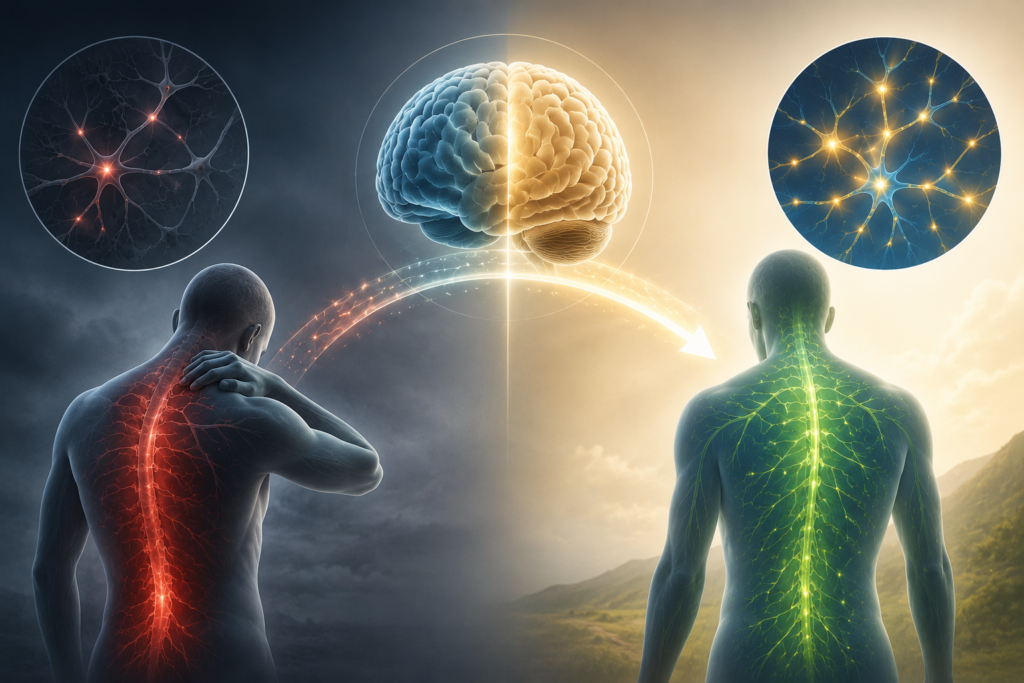
This is precisely why the JAMA review’s recommendation for chronic low back pain centres on combined approaches — exercise, psychological therapies, and integrative treatments like acupuncture together — rather than any single intervention in isolation. Each of these engages the nervous system from a different angle.
Acupuncture’s specific contribution may be its ability to influence both local tissue and central nervous system pain processing simultaneously, which is part of why it appears alongside, rather than instead of, the other first-line options. Our Neuro-Acupuncture for Chronic Low Back Pain page covers this clinical approach in more detail.
This nervous-system-first lens is also what distinguishes how we approach chronic low back pain at our Ottawa clinic, we are not only addressing the lumbar region itself, but the broader pain processing system that may be maintaining the pain beyond the point of tissue healing.
What This Means If You're Searching for Back Pain Relief in Ottawa
Research findings can help inform conversations with healthcare professionals, but treatment decisions should always be individualized.
- If your low back pain is recent (less than 6 weeks):
Many episodes of acute nonspecific low back pain improve over time. Current clinical guidelines generally encourage people to remain as active as their symptoms allow and to avoid prolonged bed rest where appropriate. Depending on individual circumstances, healthcare providers may discuss options such as exercise, manual therapies, acupuncture, heat application, or other conservative approaches.
- If your symptoms have persisted for more than 12 weeks:
Chronic low back pain is often influenced by multiple biological, psychological, and social factors. For this reason, many clinical guidelines support a multidisciplinary approach that may include exercise-based rehabilitation, education, self-management strategies, psychological interventions, and other supportive therapies when appropriate.
- When to seek medical assessment:
While most low back pain is classified as nonspecific, certain symptoms warrant prompt medical evaluation. These may include unexplained weight loss, fever, significant trauma, progressive weakness, loss of sensation, or changes in bladder or bowel function. A healthcare professional can help determine whether further assessment is needed and rule out less common but potentially serious causes of back pain.
Frequently asked questions
Neuroplasticity is the brain's ability to reorganise itself by forming new connections and strengthening existing pathways. It means the brain is not fixed, it adapts continuously in response to experience, learning, injury, and therapeutic input. This capacity for change is what makes recovery from neurological conditions possible.
Acute low back pain (under 6 weeks) is usually managed with activity modification, heat, and first-line treatments such as acupuncture, spinal manipulation, or short-term medication. Chronic low back pain (over 12 weeks) typically requires a more structured, multidisciplinary approach involving exercise, psychological therapies, and ongoing integrative care such as acupuncture.
Acupuncture is well-studied for general low back pain. For sciatica — where pain radiates down the leg, or there is numbness or weakness — a proper assessment is important first, since the cause may be different. We assess both at our Ottawa clinic and can help determine whether acupuncture is appropriate for your specific presentation. Learn more about how we approach sciatica.
💡 Remember
Recovery is not a straight line. There will be good days and challenging days. What matters is consistent effort, appropriate support, and the courage to explore treatments that might help you reach your fullest potential. Neuroacupuncture is one more tool in your recovery toolkit—a tool backed by thousands of years of clinical experience and increasingly by modern research.
Scientific References
- Cashin, A.G., Chou, R., Weimer, M.B., & McAuley, J.H. (2026). Low Back Pain: A Review. JAMA. Published online June 15, 2026. View study →
This article is for informational and educational purposes only and is not a substitute for professional medical advice, diagnosis, or treatment. Always seek the advice of your physician or other qualified health provider with any questions you may have regarding a medical condition. Never disregard professional medical advice or delay in seeking it because of something you have read in this article.
Table of Contents

About Denis Grounin →
Denis Grounin, former ER nurse practitioner, R.TCMP, R.Ac, is the Founder of Sunrise Neuro Acupuncture Integrative Clinic in Ottawa with over 30 years of acupuncture experience and neurological training since the 1990s. His work focuses on neuro-acupuncture, rehabilitation support, and integrative neurological care.
Learn more about integrative medicine
- All
- Gastrointestinal
- Infections
- integrative medicine
- Mental
- Musculoskeletal
- Neurological
- Skin
- Women's Health

How Common Are Sensory Processing Difficulties in Children?
Low Back Pain Treatment in 2026: What Research Now Shows
What Is Neuroplasticity? The Brain’s Ability to Adapt
Looking for a treatment?
Experience the benefits of Traditional Chinese Medicine with personalized care for your health.